
Fuse vs Circuit Breaker: How to Tell the Difference and When It Matters
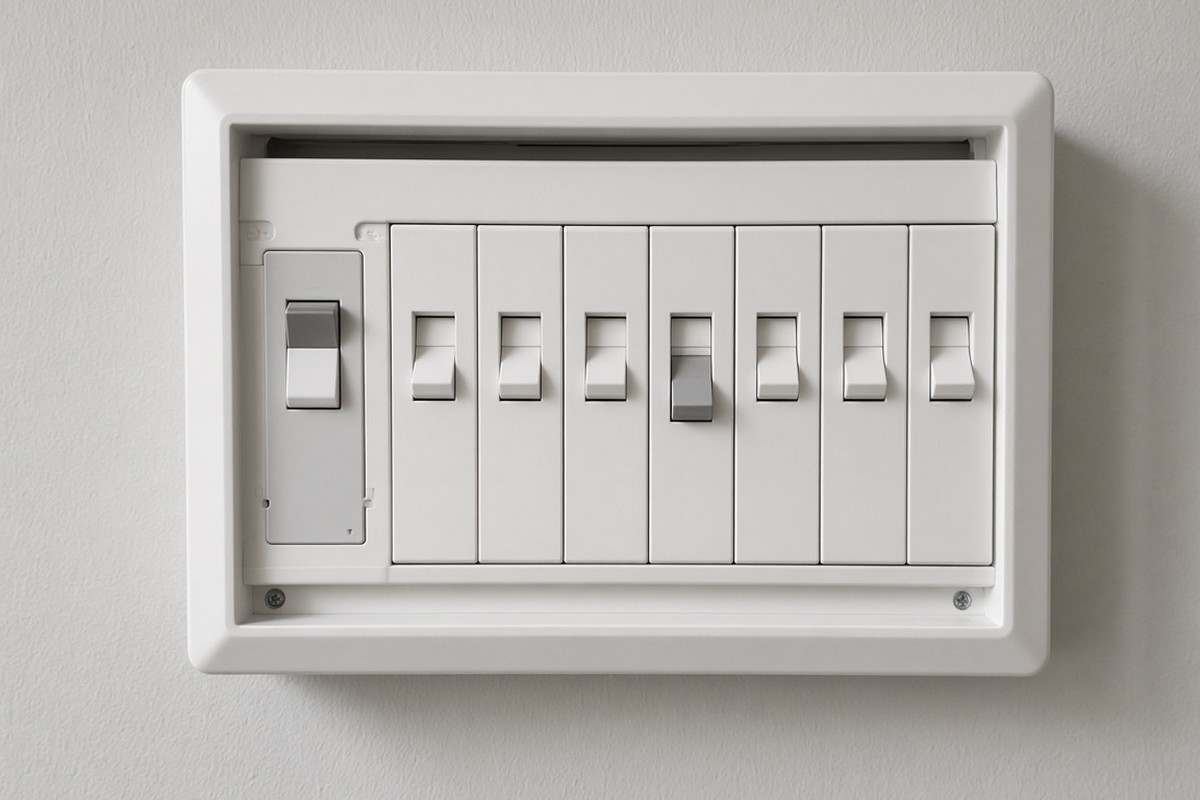
Open the cupboard under the stairs and you will find either fuses or circuit breakers. Both protect cables from overloads and short circuits, but they work differently, are reset differently and say a lot about the age of the installation. This guide shows how to tell them apart, how each works, how to restore power safely and when an old fuse box should be upgraded.
How to Tell What You Have
| What you see | What it is | Typical age |
|---|---|---|
| White or brown ceramic carriers you pull out, with wire across them | Rewireable fuses | Usually before the 1980s |
| Carriers containing a sealed cartridge | Cartridge fuses | 1960s to 1990s |
| Rows of small switches that flip down | Miniature circuit breakers (MCBs) | 1980s onwards |
| A larger switch with a "T" or "Test" button | RCD | 1990s onwards |
| Small switches with a test button each | RCBOs | 2000s onwards |
| A wooden back board, metal casing or very old switches | Old installation, check urgently | Often 1950s to 1970s |
How a Fuse Works
A fuse contains a thin wire designed to melt when too much current passes through it. When it melts, the circuit is broken. A rewireable fuse has fuse wire stretched between two terminals in a ceramic carrier. A cartridge fuse has the wire sealed inside a tube.
Fuses work, but they have drawbacks:
- They are slower to react than modern breakers.
- Rewireable fuses can be "repaired" with the wrong wire, removing protection.
- They give no protection against electric shock from earth leakage.
- Replacing them in the dark is awkward.
How a Circuit Breaker Works
An MCB has a thermal element that trips on sustained overload and a magnetic element that trips instantly on a short circuit. When it trips, the switch drops to off. Once the fault is cleared, you can switch it back on. MCBs are more precise than fuses and cannot be "uprated" with the wrong wire.
RCDs and RCBOs
An RCD protects people by detecting current leaking to earth and switching off in a fraction of a second. An RCBO combines an MCB and an RCD for one circuit. See RCD vs RCBO explained.
Restoring Power: Fuses
- Switch off the main switch.
- Find the blown fuse: a rewireable fuse will have a broken or scorched wire; a cartridge fuse may need testing.
- Unplug appliances on that circuit.
- Replace the fuse wire or cartridge with exactly the same rating. Never use a higher rating, and never use anything other than fuse wire.
- Refit the carrier and switch the main switch back on.
If the fuse blows again, there is a fault. Leave it and call an electrician.
Restoring Power: Circuit Breakers
- Find the tripped breaker, which will be in the off position or in the middle.
- Unplug appliances on that circuit.
- Switch the breaker fully off, then back on.
- If it trips again immediately, the fault is in the wiring. If it only trips with one appliance, that appliance is faulty.
See how to find what is tripping your electrics.
Why Upgrade an Old Fuse Box
Old fuse boxes are not necessarily dangerous, but they often mean:
- No RCD protection on socket circuits.
- Old wiring that has not been checked.
- Plastic or wooden cases that are not fire-resistant.
- Possible asbestos in older boards.
- Fuse wire that has been replaced with the wrong rating.
A modern consumer unit with RCBOs or dual RCDs, in a non-combustible enclosure, gives far better protection. Before replacing a board, the circuits must be tested. See consumer unit replacement and consumer unit size guide.
Signs Your Board Needs Attention
- Burning smell or scorching.
- Buzzing or crackling.
- Fuses that blow frequently.
- A board that feels warm.
- Damage, cracks or missing covers.
- No RCD protection.
Frequently Asked Questions
Are fuse boxes illegal?
No. But they lack modern protection and should be checked.
Can I rewire a fuse myself?
You can replace fuse wire with the correct rating, but if it keeps blowing, call an electrician.
Why does my breaker keep tripping?
An overload, a faulty appliance or a wiring fault. Testing finds which.
How much does a new consumer unit cost?
See our cost guide.
Old Fuse Box?
Call us to test your circuits and advise on upgrading. See fuse box tripping repairs.