
Signs Your House Needs a Rewire: A Room-by-Room Checklist
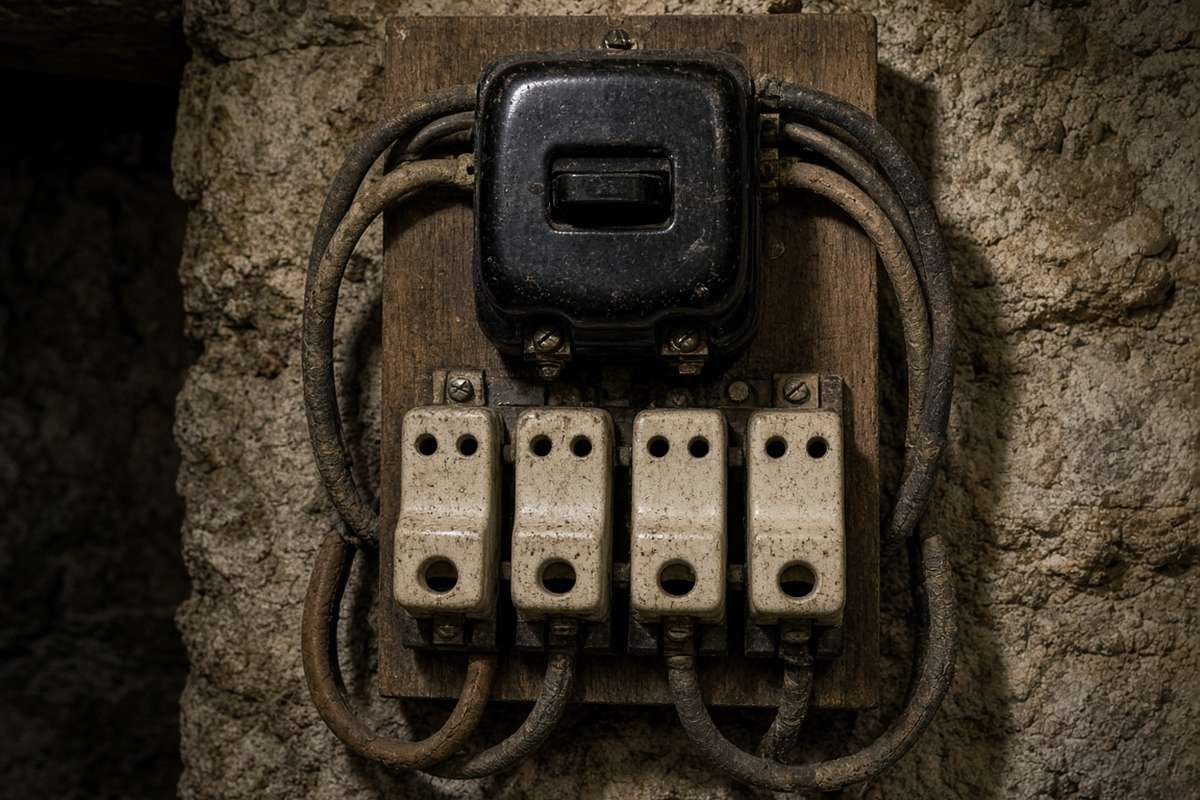
There is no fixed age at which a house must be rewired. Many installations last 25 to 40 years, some much longer, but condition decides it, not the date on the fuse board. This checklist walks through the warning signs room by room, explains which ones mean "rewire" and which mean "repair", and shows how an EICR settles the question for a Bath home.
Why Age Alone Does Not Decide It
People often ask whether a house "needs rewiring because it is 30 years old". The honest answer is that age is a prompt to check, not a verdict. PVC-insulated cable, which most homes have had since the 1960s, can last for decades if it has not been overloaded, overheated or damaged. Older cable types are a different story, and so is any installation that has been extended, patched and altered many times.
Bath has a lot of both. Georgian and Victorian houses here have often been wired, rewired and partly rewired again over the last hundred years, so one house can contain cable from three or four different eras. A flat in a converted townhouse may have modern sockets on circuits that start in a 1970s board in the basement. The only way to know what you have is to look and test.
Signs Throughout the House
These signs apply wherever you look, and any one of them is worth investigating:
- An old fuse box with rewireable fuses. A board with white ceramic carriers and fuse wire usually dates the installation and almost always means no RCD protection.
- No RCD at all. If there is no button marked "T" or "Test" on the board, nothing is protecting people from electric shock on those circuits.
- Old cable types. Rubber-insulated cable with black fabric covering, or lead-sheathed cable, was installed before the 1960s and becomes brittle with age.
- Round-pin sockets or sockets on skirting boards. These usually point to wiring from before the 1960s.
- Frequent trips, flicker or burning smells. These are symptoms, not proof of a rewire, but they need finding.
- Black and red wires at a light switch or socket. Black and red were the standard colours until 2004, so on their own they are not a problem, but they help date the installation. See old vs new cable colours.
Room by Room
| Room | What to look for | Why it matters |
|---|---|---|
| Kitchen | Too few sockets, extension leads, scorching behind appliances | Kitchens carry the heaviest loads in most homes |
| Bathroom | No RCD, old pull-cord switches, fittings without an earth | Water and electricity together need full protection |
| Living rooms | Single sockets, multiple adaptors, warm plugs | Overloaded sockets are a common fire cause |
| Bedrooms | Old ceiling roses, brittle flex, two-pin sockets | Old flex cracks as it is moved |
| Loft | Crumbling cable, junction boxes on joists, cables under insulation | Lofts hide old cable and heat build-up |
| Cellar | Corrosion on fittings, damp walls, old boards | Damp corrodes terminals and breaks down insulation |
| Outside | Old outside lights, cracked sockets, cable on walls | Water gets in and trips the power |
The kitchen test
Count the double sockets on your kitchen worktop. If you regularly unplug the kettle to use the toaster, or there is an extension lead behind the microwave, the installation was not designed for how the room is used now. That is not always a rewire, but it is a sign the circuits are being pushed.
The Signs That Mean "Repair", Not "Rewire"
Not every warning sign means the whole house needs doing. Many problems are local:
- A single scorched socket usually needs that socket and its cable ends replacing, not the whole circuit.
- A tripping RCD is often caused by one appliance or one outside light.
- A flickering light can be a loose connection at one fitting.
- An old board on otherwise sound wiring can often be replaced on its own with a modern consumer unit.
This matters because a full rewire is expensive and disruptive. Anyone who recommends one without testing, or on the strength of one fault, should be asked to explain the test results that support it.
The Signs That Usually Do Mean "Rewire"
Some findings point strongly towards rewiring all or part of a house:
- Rubber-insulated or lead-sheathed cable that is still in use.
- Low insulation resistance readings across several circuits, showing the cable is breaking down.
- No circuit protective conductor (earth) on lighting circuits throughout the house.
- Widespread heat damage, or many joints buried in walls and floors that cannot be inspected.
- An installation so altered over the years that the circuits cannot be traced or tested reliably.
How an EICR Settles It
An Electrical Installation Condition Report is the proper way to answer the question. An electrician inspects and tests each circuit, records the readings and codes any problems as C1 (danger present), C2 (potentially dangerous), C3 (improvement recommended) or FI (further investigation). See EICR codes explained.
The report tells you whether the installation is satisfactory for continued use. If it is not, the codes show whether targeted repairs will fix it or whether the problems are widespread enough that rewiring is the better value. A good report explains this in plain English.
How often to check
For an owner-occupied home, the usual recommendation is an EICR every 10 years, or when you move in. Rented homes in England need one at least every 5 years. If you have just bought an older house in Bath and have no report, it is worth arranging one before you decorate.
What a Rewire Involves in a Period Home
Rewiring a Georgian or Victorian house is slower than a modern semi. Lime plaster, cornices, shutters and original floorboards need protecting. Electricians follow existing routes where they can, lift floorboards carefully and avoid chasing historic plaster. In listed buildings, some changes may need consent. See rewiring listed buildings in Bath and how long a rewire takes.
Planning the Work
If the report says a rewire is needed, it rarely has to be done all at once:
- Dangerous items (C1) are made safe straight away.
- Potentially dangerous items (C2) are repaired promptly.
- A rewire can often be done floor by floor, or circuit by circuit.
- Decorating should wait until the electrical work is finished.
Frequently Asked Questions
How much does a rewire cost?
It depends on the size of the house, access and how much making good is needed. A small flat costs far less than a five-storey townhouse. Get a written quote after a survey and EICR, not a guess over the phone.
Can I rewire in stages?
Yes, often floor by floor or circuit by circuit. Each stage should be tested and certified, and the consumer unit is usually replaced first or as part of the first stage.
Is black and red wiring dangerous?
Not on its own. Black and red were the standard colours until 2004. What matters is the condition of the cable and the test results, not the colour.
Do I have to rewire before selling?
No. But buyers' surveyors often flag old wiring, and the TA6 form asks about electrical work. A recent EICR gives you facts to share. See selling a house: electrical certificates.
Planning a Rewire?
Start with testing, not guessing. Our fault finding and consumer unit replacement services cover homes across Bath. Contact us to arrange a visit.